Compression wear has existed for decades in medical settings — prescribed by doctors, worn by patients recovering from surgery, used to manage chronic venous conditions. The science is not new. What's new is elegant, everyday compression that women actually want to wear.
Here's what the research actually shows — and why it matters for every woman who stands, moves, and gives her best all day.
How Your Body Moves Fluid
Your heart pumps blood downward through arteries to your legs efficiently. The challenge is the return journey — pushing blood back up against gravity through your veins.
Your body uses two primary mechanisms for this:
The calf muscle pump — when you walk, your calf muscles contract and squeeze the veins in your lower legs, pushing blood upward. This is why movement is so important.
Venous valves — one-way valves in your veins help stop blood from flowing backward. When these valves weaken or when you stand still for long periods, blood can pool in your lower legs — causing the swelling, aching, and heaviness that women in standing professions know well.
Your lymphatic system faces a similar challenge — it has no pump at all, relying entirely on muscle movement and external pressure to move lymph fluid through your body.
What Graduated Compression Does
Graduated compression garments apply external pressure that mimics and supports both systems.
The key word is graduated — firmest at the ankle, decreasing gradually toward the thigh. This pressure gradient does what your calf muscle pump cannot do alone when you're standing still:
It pushes blood and lymph fluid upward, away from areas prone to pooling. It reduces the diameter of superficial veins, increasing flow velocity. It helps reduce the fluid leakage from capillaries that causes visible swelling.
The result is measurable — studies consistently show that graduated compression at 15–20 mmHg reduces limb volume, decreases swelling, and reduces the subjective experience of leg fatigue in people who stand or sit for extended periods.
The Evidence — What Research Shows
Decades of clinical research support graduated compression:
For venous conditions — compression therapy is a first-line treatment for chronic venous insufficiency and varicose veins, with strong evidence for reducing symptoms and slowing progression.
For post-surgical recovery — graduated compression is standard care after many surgical procedures, reducing the risk of deep vein thrombosis and accelerating recovery.
For occupational standing — studies of healthcare workers, retail employees, and airline staff consistently show that compression wear reduces end-of-shift leg volume, swelling, and fatigue compared to no compression.
For travel — the evidence for compression reducing DVT risk on long flights is well-established, which is why many airlines recommend compression for both passengers and crew.
How to Improve Lymphatic Drainage in Your Legs
Your lymphatic system has no pump of its own — it relies entirely on muscle movement, breathing, and external pressure to move lymph fluid out of your legs. When you stand or sit for hours, lymph stagnates, and that's a major reason your ankles swell and your calves feel heavy by evening.
The four most effective ways to improve lymphatic drainage in your legs are simple and stack well together:
Move the calf muscle pump. Calf raises, ankle circles, and short walks every 30–45 minutes do more for lymphatic flow than any product. Movement is the lymphatic system's engine.
Elevate above heart level. Ten to fifteen minutes with your legs up the wall lets gravity drain pooled lymph fluid back toward your core.
Dry brushing and self-massage. Long, light strokes upward toward the heart along the calves and thighs follow the natural direction of lymph flow and visibly reduce puffiness.
Graduated compression or lymphatic leggings. External pressure replaces what your stationary muscles can't deliver — particularly important during long shifts, long flights, and post-surgery recovery.
For a deep dive into lymphatic leggings specifically — the difference between medical compression and lymphatic-targeted designs, and which brands are worth the money — see our sister site Lymphatic Leggings Guide.
Read the full guide to improving lymphatic drainage in your legs
What This Means for You
| Your Situation | What's Happening | How Compression Helps |
|---|---|---|
| Flight attendant at altitude | Reduced cabin pressure allows fluid to pool | Replaces atmospheric pressure, keeps fluid moving |
| Standing 8+ hours at work | Calf muscle pump slows, fluid pools | Provides external pressure that supplements the pump |
| Post-surgery recovery | Lymphatic drainage disrupted | Supports lymphatic flow, reduces bruising and swelling |
| Pregnancy swelling | Increased blood volume, hormonal changes | Reduces oedema in ankles and legs |
| Long-haul travel | Prolonged sitting, reduced movement | Prevents DVT risk, reduces swelling |
Choosing the Right Compression
The science only works when the compression level is appropriate for your needs.
Too light — below 10 mmHg — provides minimal therapeutic benefit beyond general comfort.
Too firm — above 30 mmHg — can be counterproductive if not needed, and may restrict circulation if worn without proper fitting guidance.
For most women in standing professions — flight attendants, nurses, retail workers, teachers — 15–20 mmHg is the commonly recommended sweet spot. Effective enough to make a measurable difference. Comfortable enough to wear all day, every day.
VIM & VIGR Nylon Footless Compression Tights (15–20 mmHg)
Class 1 graduated compression in a footless nylon tight, covering ankle to waist. The footless cut lets you wear your own socks or knee-highs and keeps shoe fit unchanged.
Best for: Daily wear, flight attendants, standing professions
Pros
- ✓ 15–20 mmHg graduated compression
- ✓ Full-leg coverage from ankle to waist
- ✓ Footless: pairs with your own socks or hosiery
Cons
- ✗ Footless edge shows at the ankle with open shoes or skirts unless layered
- ✗ Size by ankle and calf measurement, not dress size
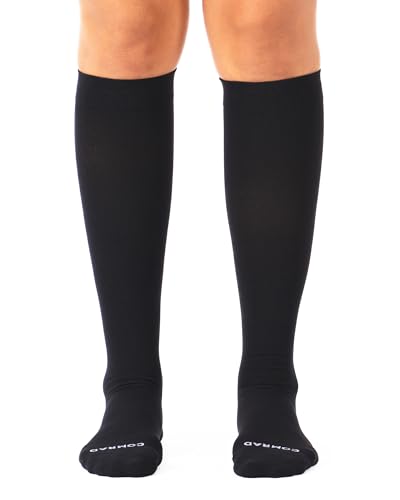
Comrad Compression Socks — 15–20 mmHg
Medical-grade graduated compression in a professional, stylish sock. The evidence-based choice for women who want targeted ankle and calf support.
Best for: Targeted compression, healthcare workers, daily wear
Pros
- ✓ Certified 15-20 mmHg
- ✓ Comfortable all-day wear
- ✓ Professional designs
- ✓ Pairs with any legging or trouser
Cons
- ✗ Ankle and calf only
- ✗ Not full-leg compression
Compression leggings: benefits and who they're for
Compression leggings apply the same graduated pressure as knee-high socks but cover from ankle to waist. This makes them more effective when circulation issues extend to the thigh, and more practical for women who prefer one garment over socks layered with other pieces.
The benefits are most noticeable in three situations. For anyone standing on hard floors in warmer environments, nurses, teachers, retail workers, full coverage keeps circulation moving throughout the entire lower body, which means less total fatigue by end of shift. For flight attendants, a compression legging replaces both socks and shorts in a single layer, useful when changing between pieces isn't practical during a 14-hour duty day. For post-exercise recovery, wearing compression leggings for one to two hours after training supports lymphatic clearance in the legs. (Source: PMC4081237)
The most important spec to check: the legging must be graduated, tightest at the ankle, easing off as it goes up. Many sportswear leggings are labeled "compression" but apply uniform pressure throughout. They look the same but don't provide circulatory benefit.
At 15 to 20 mmHg, options like the SIGVARIS Soft Silhouette Leggings and Rejuva Compression Seamless Leggings are designed for all-day wear and hold their compression through repeated washing. For women managing lymphedema or post-surgical recovery, condition-specific guidance is available at LymphaticLeggingsGuide.com.
Frequently Asked Questions
Ready to find the right compression for your life?
Shop Our Top Picks