There is a particular kind of exhaustion that only flight attendants understand. It lives in your legs — that heavy, swollen feeling after the fourth sector of a long-haul day. Your smile stays perfect. Your ankles tell a different story.
The right compression tights change this. Not by magic — by graduated pressure that works with your body throughout every hour of your shift. Here are the ones we recommend most.
What Flight Attendants Actually Need
Most compression products are designed for occasional travellers — someone on a single long flight, once a year. Flight attendants need something entirely different.
You need tights that survive daily wear across hundreds of flights. That disappear completely under your uniform. That feel comfortable in hour twelve, not just hour one. And that genuinely help limit the swelling that builds with every sector.
The bar is high. These brands meet it.
Our Top Picks
VIM & VIGR Nylon Footless Compression Tights (15–20 mmHg) — Best Full-Leg Option
Class 1 graduated compression in a footless nylon tight, covering ankle to waist. The footless cut lets you wear your own socks or knee-highs and keeps shoe fit unchanged.
Best for: All airlines, long-haul flights, daily wear
Pros
- ✓ 15–20 mmHg graduated compression
- ✓ Full-leg coverage from ankle to waist
- ✓ Footless: pairs with your own socks or hosiery
Cons
- ✗ Footless edge shows at the ankle with open shoes or skirts unless layered
- ✗ Size by ankle and calf measurement, not dress size
For a full comparison of lymphatic vs compression options specifically for flight attendants, see our dedicated guide at Lymphatic Leggings Guide.
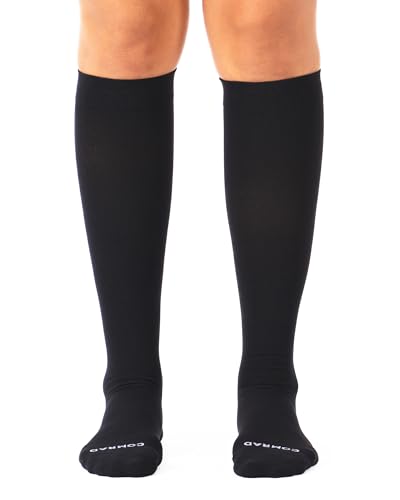
Comrad Compression Socks — For Recovery Days
On positioning flights, commutes, and recovery days, Comrad compression socks are the choice of many flight attendants who want targeted ankle and calf support without full tights. Discreet, professional, and genuinely effective.
Best for: Recovery between flights, positioning sectors, pairing with leggings
Pros
- ✓ 15-20 mmHg certified compression
- ✓ Professional appearance in any setting
- ✓ Exceptional durability
- ✓ Comfortable for extended wear
Cons
- ✗ Ankle and calf only — not full leg
- ✗ Not a replacement for full compression tights
The Science Behind Swollen Legs at Altitude
At cruising altitude, cabin pressure drops to the equivalent of 6,000–8,000 feet above sea level. Lower atmospheric pressure means less external force pushing against your legs — allowing fluid to pool more easily in your ankles and feet.
Add prolonged standing, restricted movement, and dry cabin air that accelerates dehydration — and you have the perfect conditions for the swelling that every flight attendant knows too well.
Graduated compression tights work by providing the external pressure your body loses at altitude, encouraging blood and lymph fluid to move upward rather than pooling in your lower legs.
How to Wear Them for Maximum Benefit
Put them on before you leave home — before your legs have had a chance to swell. Compression helps limit swelling; it doesn't reverse it.
Wear them throughout your entire shift — from pre-flight briefing to post-flight shutdown.
Stay hydrated — compression works best when your body is properly hydrated. Aim for water consistently through your shift, not just when you feel thirsty.
Remove before sleeping — your lymphatic system works differently when you're horizontal. Compression during sleep is generally unnecessary.
Going Deeper on Compression?
If you're managing lymphatic swelling or need medical-grade compression for long-haul travel, the dedicated guide on LymphaticLeggingsGuide.com covers flat-knit vs. circular-knit construction, mmHg by situation, and 2026 product picks specifically for long-haul flights.
Best Lymphatic Leggings for Long-Haul Flights: 2026 GuideRead next
Best Shapewear for Travel & Long Shifts — Truly Invisible Under Uniforms
The shapewear that actually stays put through a 12-hour rotation, without rolling, digging, or showing under tailored uniforms.
Frequently Asked Questions
Want to understand more about how compression works and which level is right for you?
The Science of Support