By hour six, you feel it. A dull ache that starts in your calves and works its way up. Your feet feel heavier than they should. Your lower back has joined the protest.
This is the reality for millions of women — flight attendants, nurses, retail workers, teachers — whose working days are measured not in steps but in hours spent upright.
The good news: leg pain from prolonged standing is something that can often be reduced. Here's what actually works.
Why Standing All Day Hurts
The human body is designed for movement, not sustained static posture. When you stand in one position for extended periods, several things happen simultaneously:
Your calf muscles — which act as pumps to push blood back up toward your heart — slow down without the movement that activates them. Blood and fluid pool in your lower legs.
The cartilage in your joints, particularly your knees and hips, compresses under sustained load without the relief that movement provides.
Your lower back muscles fatigue as they work continuously to maintain upright posture without the natural relief of walking.
The result: swelling, aching, fatigue — and a body that feels ten years older by the end of your shift.
The Foundation — What You Wear Matters Most
Before strategies and rituals, the foundation is this: what you put on your body before your shift determines how your body feels at the end of it.
Compression — graduated compression leggings or tights at 15–20 mmHg are one of the most effective preventive measures for women who stand all day. They provide the external pressure your calf muscles need to keep fluid moving upward.
Supportive footwear — shoes with adequate arch support and cushioning reduce the impact on joints and reduce lower back fatigue significantly.
These two things alone — compression and proper footwear — will change how your legs feel after a long shift more than any other single intervention.
VIM & VIGR Nylon Footless Compression Tights (15–20 mmHg)
Class 1 graduated compression in a footless nylon tight, covering ankle to waist. The footless cut lets you wear your own socks or knee-highs and keeps shoe fit unchanged.
Best for: Flight attendants, nurses, all-day standing
Pros
- ✓ 15–20 mmHg graduated compression
- ✓ Full-leg coverage from ankle to waist
- ✓ Footless: pairs with your own socks or hosiery
Cons
- ✗ Footless edge shows at the ankle with open shoes or skirts unless layered
- ✗ Size by ankle and calf measurement, not dress size
Movement Strategies That Actually Help
You can't always walk — but you can always move.
Calf raises — standing on your toes and lowering repeatedly activates the calf muscle pump even when you can't walk. Do 20 reps every 30–45 minutes.
Weight shifting — consciously shifting your weight from one foot to the other reduces static load on joints and keeps circulation moving.
Ankle rotations — slow circles with each foot for 30 seconds maintains ankle mobility and activates the lymphatic system in your lower legs.
These micro-movements take seconds and make a measurable difference to how your legs feel by the end of a long shift.
Hydration — The Overlooked Factor
Dehydration contributes directly to leg fatigue and swelling. When you're dehydrated, your body retains fluid in your extremities as a protective response — making swelling worse, not better.
The counterintuitive truth: drinking more water reduces swelling, not increases it.
For flight attendants, dry cabin air accelerates fluid loss significantly. Aim for 250ml of water per hour of flying — more than you think you need.
End-of-Shift Recovery Rituals
What you do in the first hour after your shift determines how quickly your body recovers.
Elevate immediately — lie down and raise your legs against a wall or on pillows for 15–20 minutes. This is the single most effective post-shift recovery position.
Cool water — a cool foot bath for 10 minutes constricts blood vessels and reduces inflammation.
Gentle walk — a 20-minute walk after a long shift activates your calf muscles and clears pooled fluid faster than any passive recovery.
Remove compression before sleeping — your lymphatic system works differently horizontal. Compression during sleep is generally unnecessary.
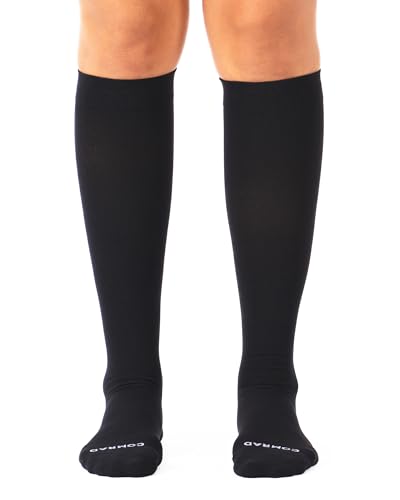
Comrad Compression Socks
For targeted ankle and calf support during recovery and on lighter days. Comfortable, professional, and genuinely effective for women who stand all day.
Best for: Recovery days, lighter shifts, pairing with leggings
Pros
- ✓ 15-20 mmHg certified compression
- ✓ Comfortable for all-day wear
- ✓ Professional appearance
- ✓ Great for recovery between shifts
Cons
- ✗ Ankle and calf only
- ✗ Not full-leg coverage
How to Reduce Swelling in Legs and Feet After Standing
Swelling in the legs and feet after a long day on your feet is a circulatory response, not just tiredness. When you stand for extended periods, the calf muscle pump that drives blood back up to the heart works against gravity continuously; fluid gradually accumulates in the lower legs as venous return slows.
Three things make a measurable difference:
Compression during your shift. Wearing 15 to 20 mmHg compression socks while standing helps reduce fluid pooling in the first place. This is more effective than any post-shift intervention. (Source: PMC4081237)
Elevation after your shift. Lying with your legs raised above heart level for 20 minutes accelerates fluid return from the lower extremities. A pillow under your calves is enough, no specific angle required.
Contrast footbath. Alternating cool and warm water (one minute each, three rounds) stimulates vascular constriction and dilation, which helps clear residual swelling faster than rest alone.
If your feet are still visibly swollen the morning after a shift, it's worth discussing a higher compression level (20 to 30 mmHg) with your GP. Persistent overnight swelling can indicate a venous condition that benefits from medical assessment.
For a full post-shift recovery routine, see How to Reduce Swollen Feet After a Long Shift.
How to Relieve Leg Pain from Standing All Day
If the pain is already there at the end of a shift, relief comes from a sequence — not a single fix. Here's what actually works to relieve leg pain from standing all day, in the order to do it:
1. Elevate above heart level (15–20 min). Lie flat, legs up the wall or on stacked pillows. This drains pooled fluid faster than anything else and is the fastest way to relieve aching, heavy legs.
2. Cool — not cold — water. A 10-minute cool foot bath or a quick cool rinse on the calves constricts swollen veins and calms inflammation.
3. Gentle calf stretches and ankle circles. Reactivate the calf muscle pump that's been static for hours. Two minutes is enough to start clearing lactic acid and fluid.
4. Hydrate and replace electrolytes. Dehydration makes leg pain worse, not better. A large glass of water with a pinch of salt or an electrolyte tab speeds recovery.
5. Sleep without compression. Compression is for the shift, not the night. Your lymphatic system clears overnight on its own once you're horizontal.
The most overlooked piece: relief is easier when pain never reaches a 7 in the first place. Wearing 15–20 mmHg graduated compression during your next shift means there's much less pain to relieve at the end of it.
Frequently Asked Questions
Discover the science behind why compression works — and how to choose the right level for you.
The Science of Support