Supporting your body at work doesn't have to mean compromising on elegance. The right choices — in what you wear, how you move, and how you recover — can make a profound difference to how you feel at the end of a long shift. And all of them can be done beautifully.
These ten approaches are for women who stand, move and perform all day. Flight attendants, nurses, retail professionals, teachers, stylists — anyone whose work demands physical presence from first hour to last.
1. Wear Graduated Compression From the Start
Put your compression socks or tights on before your shift begins — not after your legs already feel heavy. Graduated compression works by supporting circulation continuously, not by treating swelling once it has already developed. Think of it as a foundation layer, as essential to your work uniform as anything else you put on.
2. Choose Shapewear That Works With Your Body
The right shapewear doesn't restrict — it supports. Look for pieces with breathable fabric, a comfortable waistband that doesn't roll, and a compression level suited to your shift length. Honeylove's structured pieces and Shapermint's everyday shorts are both designed to be worn for hours without discomfort.
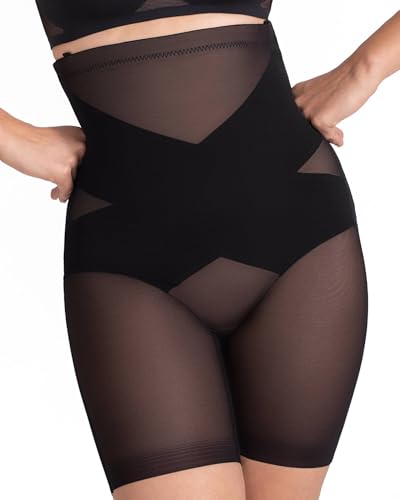
Honeylove SuperPower Short
Structured support with moisture-wicking fabric and a virtually invisible finish under uniforms. Designed to be worn all day without rolling or shifting.
Best for: Long shifts, under uniforms, all-day wear
Pros
- ✓ Structured boning helps prevent rolling
- ✓ Moisture-wicking fabric
- ✓ Invisible under clothing
Cons
- ✗ Higher price point
- ✗ Limited size range in some colours
3. Invest in Supportive Footwear
Your shoes carry everything. Supportive footwear with adequate arch support and cushioning reduces fatigue not just in your feet but through your knees, hips and lower back. Look for styles with a slight heel (2–4cm) rather than completely flat — a small elevation actually reduces calf muscle strain during prolonged standing.
4. Use Anti-Fatigue Insoles
If your work shoes don't provide sufficient cushioning, quality insoles can transform them. Memory foam or gel insoles reduce impact on joints and help distribute your body weight more evenly across the foot. A small addition that makes a significant difference over an eight-hour shift.
5. Move Intentionally Every 30 Minutes
Prolonged static standing is harder on the body than walking. Set a quiet intention to shift your weight, take a few steps, or do a few calf raises every 30 minutes. These micro-movements activate the calf muscle pump and keep circulation moving. For flight attendants, the aisle walk between service rounds serves this purpose naturally — use it deliberately.
6. Hydrate Consistently Through Your Shift
Dehydration worsens swelling, increases fatigue, and reduces your body's ability to regulate temperature. Aim for consistent small amounts of water throughout your shift rather than large amounts infrequently. Avoid excess caffeine mid-shift if you're already prone to swelling — it dehydrates.
7. Elevate During Every Break
When you have a break, elevate your legs. Even 10 minutes with your feet above hip level makes a measurable difference to swelling and fatigue. A rolled jacket under your ankles is enough. This single habit, practised consistently, accumulates into significant recovery benefit over time.
8. Layer Thoughtfully for Temperature Changes
Women who work in environments with temperature variation — aircraft cabins, hospitals, large retail spaces — benefit from thoughtful layering. Breathable base layers that wick moisture, a mid layer for warmth, and a structured outer piece that looks polished at all temperatures. Your body thermoregulates better when it's not fighting extreme temperature shifts.
9. Build a Post-Shift Recovery Ritual
What you do in the first hour after your shift ends shapes how you feel the following morning. A brief walk to activate circulation, cool water on your legs, elevation, and light stretching — these don't require much time but they consistently reduce next-day fatigue. Treat your post-shift ritual as part of the job, not an optional extra.
10. Listen to What Your Body Accumulates
Persistent swelling, recurring pain in specific areas, or fatigue that doesn't resolve with rest are signals worth taking seriously. The body adapts remarkably well to physical demands — but it communicates clearly when it needs more support. Compression level, footwear, shapewear, and movement habits can all be adjusted as your needs evolve.
Leonisa High Waisted Compression Leggings
Full-length compression leggings with a high, tummy-smoothing waist and light compression from waist to ankle for full-shift wear.
Best for: Retail workers, nurses, teachers, long standing shifts
Pros
- ✓ Waist-to-ankle compression
- ✓ High waist with tummy smoothing
- ✓ Works for work and the gym
Cons
- ✗ May feel warm in summer
- ✗ Light compression, not medical-grade
Checking availability...
Related reading
Compression socks are the easiest place to start. See our best compression socks for nurses guide for mmHg guidance, and our best compression socks for long shifts round-up for picks that last through daily wear.
Want to understand the science behind why compression works?
Read our guide → The Science of Support