Fact-checked by the ShapeAndSupport editorial team. Last reviewed 6 August 2026. Product picks are chosen on fit, fabric and uniform compatibility, not commission rates.
Compression works on long-haul, but only when the details are right. The wrong pressure class, the wrong timing, or a sock that slides down over the Gulf and you get most of the discomfort and none of the benefit.
These are the five habits that separate crew who land with normal ankles from crew who spend the layover with their feet on a pillow.
Tip 1: Choose 15 to 20 mmHg as Your Default
For healthy legs on a long sector, 15 to 20 mmHg is the working range. It is firm enough to move fluid back up the leg during hours of standing and sitting, and gentle enough to wear for a full duty without leaving marks or numb toes. Save 20 to 30 mmHg for medical advice, diagnosed venous issues, or post-surgery recovery.
An opaque knee-high in this class is the most forgiving place to start: it is easy to put on, easy to wash on a layover, and invisible under uniform trousers.
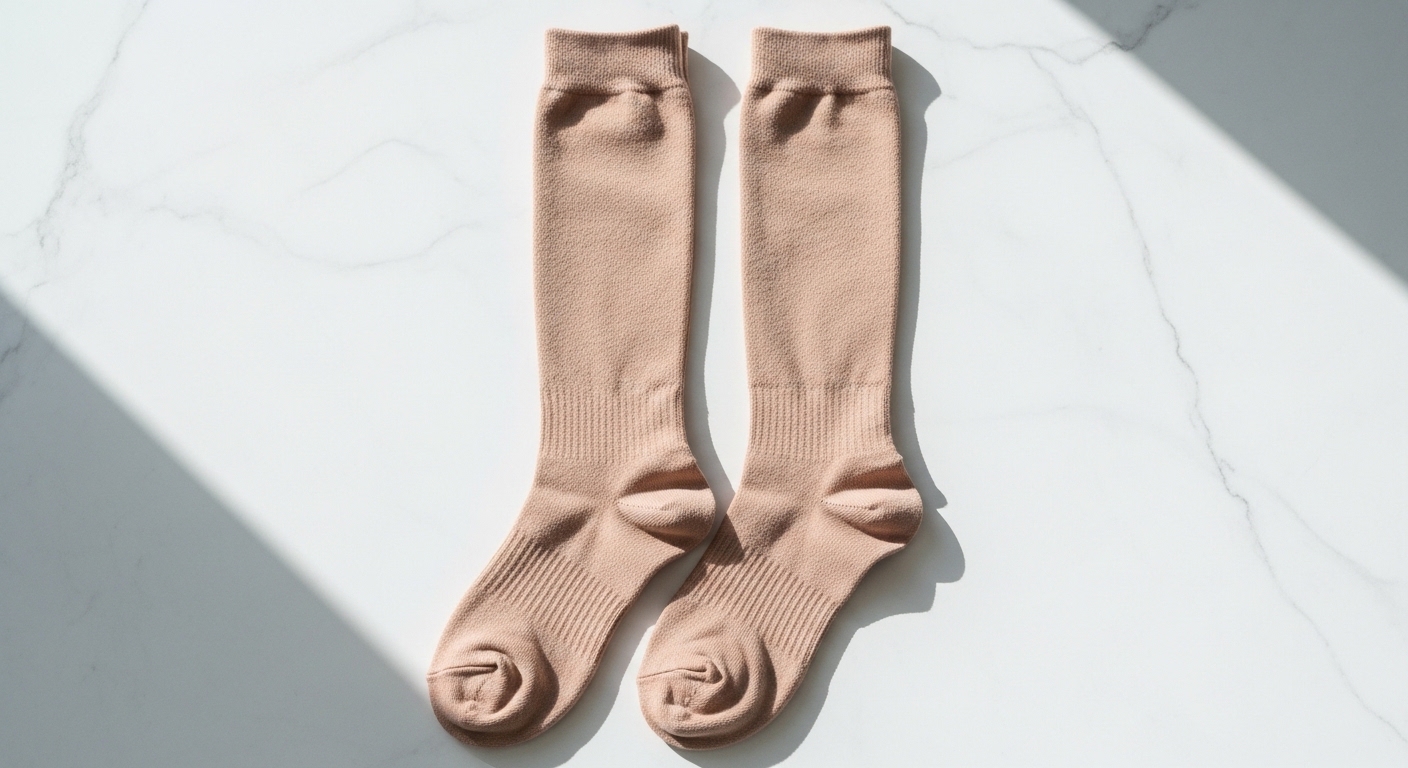
JOBST ACTIVA Opaque Knee-High 15-20 mmHg
A medical-grade knit at an everyday price. The opaque finish hides the compression look entirely under uniform trousers, and the graduated profile holds its pressure through a full rotation rather than relaxing after a few washes.
Best for: Everyday long-haul duty under trousers
Pros
- ✓ Reliable graduated pressure
- ✓ Opaque, reads as a normal sock
- ✓ Holds shape wash after wash
Cons
- ✗ Warm on summer routes
- ✗ Limited shade range
Tip 2: Put Them On Before You Leave Home
Compression helps reduce swelling far better than it reverses it. Once fluid has settled into the ankle at hour four, pulling a sock over it is both harder and less effective. Dress at home, before the commute, while the legs are at their smallest.
The same rule applies at the other end: keep them on through the transfer to the hotel, and take them off only when you can lie down and elevate.
Sigvaris Style Sheer 780 Knee-High
Sheer enough to pass as regulation hosiery while delivering true graduated compression. The fine knit makes it the easiest of the group to get on quickly in the morning, which matters when you are dressing at 4am for a report time.
Best for: Uniform skirts and early report times
Pros
- ✓ Genuine medical compression in a sheer knit
- ✓ Easy to pull on quickly
- ✓ Elegant under a skirt
Cons
- ✗ Snags more easily than opaque
- ✗ Premium price
Tip 3: Match the Denier to the Route
A thick opaque sock that is perfect on a winter night sector to Northern Europe becomes a problem on a summer Gulf turnaround. Cabin temperature, layover climate and uniform fabric all change what you can comfortably wear. Most crew end up carrying two weights and choosing per rotation.
For hot routes, a light-denier compression tight gives you leg support without the heat load of a heavy knit.
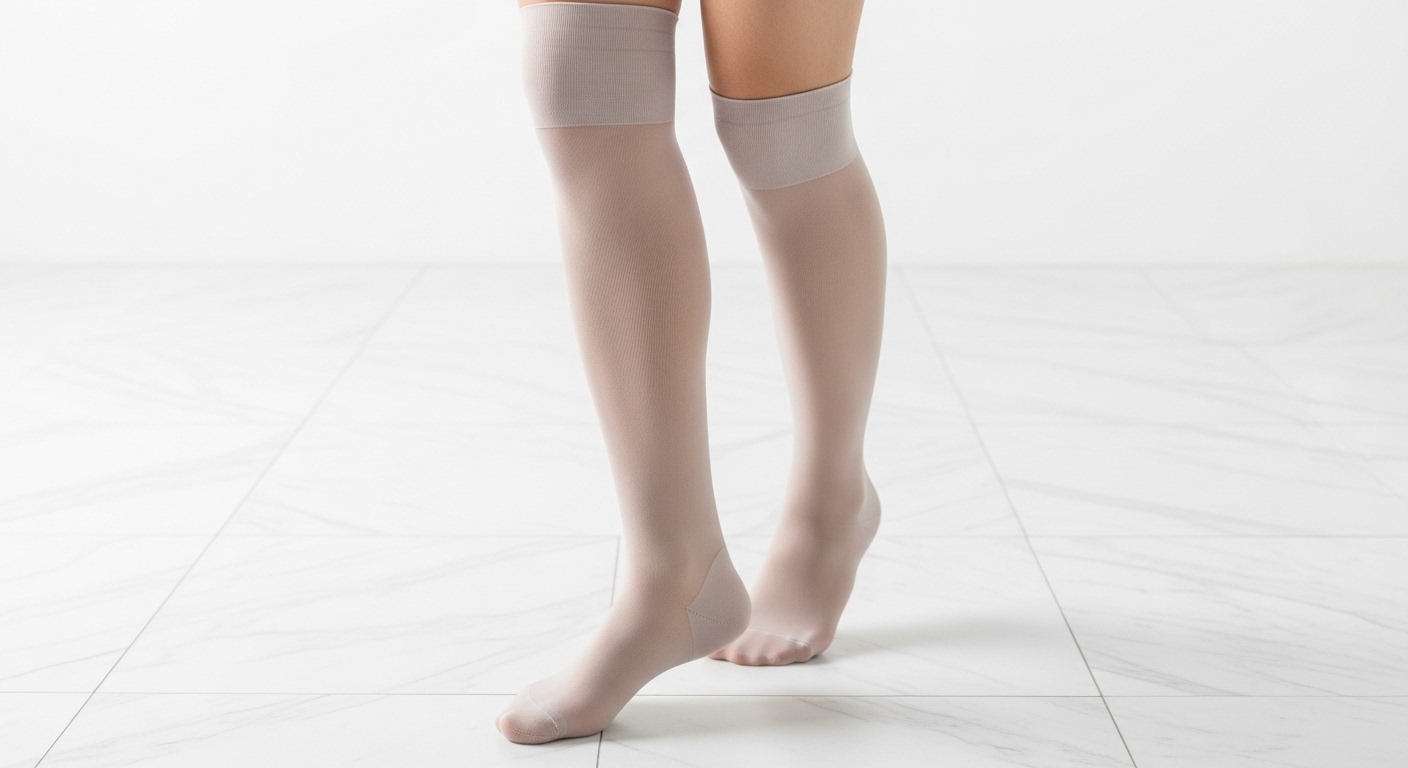
FALKE Vitalize 20 Den Compression Tights
Twenty denier with a genuine graduated profile, which is a rare combination. Light enough for summer sectors and hot layovers, with the leg support that a standard sheer tight cannot give you. The knit quality holds up to a rotation schedule.
Best for: Summer routes and warm cabins
Pros
- ✓ Very light for a compression garment
- ✓ Full-leg graduated support
- ✓ Durable fine knit
Cons
- ✗ Less support than a knee-high at the ankle
- ✗ Care label needs following
Tip 4: Fit the Calf, Not the Shoe Size
The most common compression mistake is sizing by shoe. Graduated pressure only works when the calf circumference is right: too loose and it does nothing, too tight and the top band acts as a tourniquet and traps fluid below it.
Measure the widest part of the calf first thing in the morning and buy to that number. If the band leaves a deep ring, the size is wrong, not the concept.
Comrad Nylon Knee High Socks 15-20 mmHg
A well-graded size range with a soft, wide top band that does not cut into the calf. The nylon knit is thin enough for uniform shoes and breathes better than most opaque options, which helps on the long sit-down stretches between services.
Best for: Crew between standard sizes
Pros
- ✓ Wide, non-digging top band
- ✓ Breathable nylon knit
- ✓ Clear calf-based sizing
Cons
- ✗ Thin knit shows wear sooner
- ✗ Fewer neutral shades
Tip 5: Keep a Fresh Pair in the Crew Bag
Compression garments lose pressure as the elastane fatigues, and a pair worn for two duties in a row is already doing less than it should. Rotate at least three pairs, wash after every wear, and replace every three to six months depending on frequency.
A spare pair in the bag also covers the sector where a heel goes through a toe on the way to the aircraft.
Rejuva Sheer Dot Knee-High 15-20 mmHg
A patterned sheer that looks like a fashion sock rather than a medical one, which makes it the easiest spare to keep in the bag for layover dinners and commutes out of uniform. Compression class is the same 15 to 20 mmHg as the clinical options.
Best for: Spare pair and off-duty wear
Pros
- ✓ Looks like regular hosiery
- ✓ Same 15 to 20 mmHg class
- ✓ Packs flat in a crew bag
Cons
- ✗ Pattern not uniform-compliant everywhere
- ✗ Sheer knit snags
Going Deeper on Compression?
If you want the clinical detail behind these habits, two sister guides go further: one on recovery after landing, one on how the leading brands compare head to head.
On this site, our guide to compression levels and mmHg explains how the pressure classes are measured.
Read next
How to Survive Long-Haul Flights Without Swelling
A three-phase protocol for preventing and managing leg swelling on long-haul rotations, with picks that work under uniform.
Frequently Asked Questions
Related reading
Cabin crew are not the only people managing swelling on their feet all day. If you also work ward shifts or split your week between flying and hospital work, our best compression socks for nurses guide compares the same brands at 15-20 and 20-30 mmHg, and our best compression socks for long shifts round-up covers durability across back-to-back rotations.