Fact-checked against cited clinical sources, September 2026. Written and reviewed by the Shape & Support editorial team. Informational only; not medical advice.
Many cabin crew start taking compression seriously after a turnaround where their shoes barely fit for the return leg. Ankles swell to the point where a court heel strap leaves a visible indentation that takes hours to fade, and after a couple of years in standard-issue tights it starts to feel like part of the job. It doesn't have to be.
Our editorial team has researched compression tights, socks, leggings, and shapewear from a wide range of brands, across routes from five-hour hops to sixteen hours. What follows is the routine that holds up, the products worth returning to, and the ones best left behind.
This isn't a sponsored post dressed up as personal experience. These picks are chosen independently, with no payment from brands.
Why Compression Is Different for Cabin Crew
Most compression advice online is written for passengers. Sit in your seat, elevate your feet, wear compression socks, done. That's not our reality.
We're standing for the better part of ten hours. Moving between a pressurised cabin and airport terminals, bending, reaching, lifting, all in shoes that were chosen for how they look rather than how they feel. A compression garment that works fine for a passenger in seat 14A behaves completely differently on a body that's been active since 0500.
The specific problems for cabin crew: waistbands that roll during service, cheap compression that loses its pressure profile after four hours of standing, fabrics that get uncomfortable when cabin humidity drops below 20%. These are the things I now check before buying anything.
Before the Flight: What I Put On and When
I put my compression on before I leave for the airport. Not at the airport, not in the crew bus. At home, preferably while still lying down, before my feet have had a chance to swell at all.
Timing matters. Once swelling has started, you're trying to compress fluid that's already pooled. Put compression on before that happens and you're preventing the pooling in the first place. It's a small habit that makes a real difference by hour eight.
My current pre-flight choice is the Comrad Knee High in 15 to 20 mmHg. I've worn these on routes across five continents and they hold their compression profile throughout a full rotation in a way that cheaper alternatives don't. The fabric is soft enough to wear for sixteen hours without the skin irritation I used to get from lower-quality nylon blends.
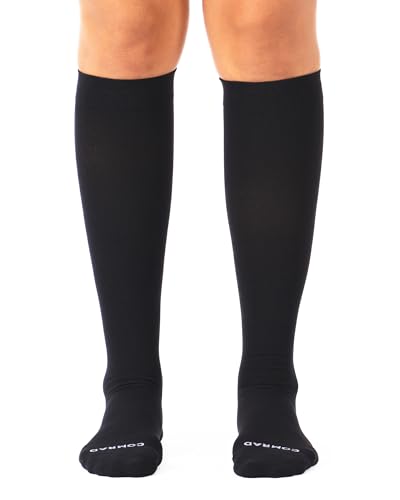
Comrad Nylon Knee High Socks, 15 to 20 mmHg Graduated Compression
Consistent graduated compression in a soft nylon-spandex blend that holds up across long-haul rotations. Breathable, moisture-wicking, and true to size.
Best for: Pre-flight wear, all-day long-haul shifts, layover recovery
Pros
- ✓ Maintains compression profile over 12+ hours
- ✓ Soft nylon-spandex blend, no skin irritation
- ✓ Holds shape after dozens of washes
Cons
- ✗ Limited colour options
- ✗ Knee-high only, no thigh-high variant
On longer routes, anything over ten hours, I also add a high-waisted compression layer underneath my uniform. The SPANX Seamless High-Waist Leggings are what I use here. Invisible under uniform trousers and they don't roll down during service. I resisted SPANX for a long time because of the price, but I went through three cheaper pairs in six weeks so the saving stopped making sense.
SPANX Look At Me Now Seamless Leggings
Invisible under uniform trousers with a high waist that stays put through an entire shift. Seamless construction means no visible lines or bunching.
Best for: Long-haul under-uniform layer, tummy support, all-day standing
Pros
- ✓ Stays in place, no rolling waistband
- ✓ Invisible under uniform
- ✓ Comfortable for 10+ hour wear
Cons
- ✗ Higher price point
- ✗ Limited compression, more smoothing than medical-grade
Checking availability...
During the Flight: What Actually Helps
For a long time I treated compression as something you put on and forget. Wear it, take it off at the hotel, done. That's not quite right.
Three things I do on every long-haul that have actually helped:
Calf raises during service. Whenever I'm standing at the galley waiting for an oven or a brew, I do slow calf raises. Ten reps, pause, ten more. The calf muscle is basically a second pump for your circulation and at altitude that matters more than on the ground.
Water over coffee. I drink water throughout the flight, not coffee or tea. Both have a mild diuretic effect and the dehydration at altitude is already working against you. I aim for around 300ml per hour.
Legs up on breaks. If I get crew rest I keep my feet elevated, propped on a pillow or the bunk edge. Twenty minutes like that during a break makes a noticeable difference to how my legs feel for the second half of the flight.
After Landing: The Hotel Recovery Routine
The hour after landing is when the work happens. Most people do nothing, watch something on their phone, and wonder why their legs still feel heavy the next morning.
My routine at the hotel takes about fifteen minutes and I've done it after every rotation for two years.
Shoes off, compression stays on. I keep my compression on for at least an hour after landing. Taking it off straight away lets fluid pool back into the lower legs quickly and that's what you're trying to avoid.
I walk for the first ten minutes if I can manage it before lying down. The calf muscle pump does more work moving than resting, and only then do I put my feet up.
Legs up. I lie flat and put my feet against the wall at roughly 45 degrees for ten minutes. It gets uncomfortable around minute six but it's the fastest thing I've found for ankle swelling.
Contrast shower. Cold on my legs for 60 seconds, warm for 60 seconds, three rounds. It's not pleasant after a long flight. It works.
Compression for sleep. After the shower I change into the Sigvaris Soft Silhouette leggings. They're 15 to 20 mmHg and footless, comfortable enough to sleep in. I started doing this about 18 months ago and my legs feel noticeably better the next morning.
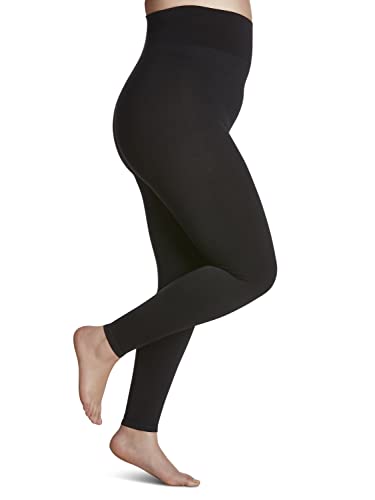
Sigvaris Soft Silhouette Leggings, 15 to 20 mmHg
Footless compression leggings designed for extended wear including overnight recovery. Soft fabric with medical-grade graduated compression.
Best for: Overnight hotel recovery, layover wear, gentle all-day compression
Pros
- ✓ Comfortable enough for sleep
- ✓ Footless design, no overheating
- ✓ Medical-grade 15 to 20 mmHg compression
Cons
- ✗ Not suitable for under uniform (visible)
- ✗ Higher price than non-medical alternatives
What I've Retired and Why
A few things I've stopped using and why.
Standard airline-issue tights are usually 8 to 12 mmHg. That's below the level where you see real benefit for standing crew. They're fine for uniform standards but they don't do much for your legs.
Cheap compression socks, anything below about £18 a pair, lose their compression quickly after washing. You end up with something that feels snug but isn't actually doing the graduated pressure thing anymore. The £12 multipack from the airport pharmacy is not the same product as a properly made compression sock.
There's also a brand I won't name that has a wide boned waistband. It rolled from about hour four and left visible marks on my waist that were still there the next morning.
Is It Worth the Expense?
Good compression garments are not cheap. A pair of Sigvaris or Comrad socks costs more than a standard pair of tights and more than the airport pharmacy option. I understand the hesitation.
The way I think about it now: I spend more time on my feet than most people spend at the gym. My circulation is dealing with something demanding, repeatedly, over years. Good compression garments are maintenance, not luxury. A pair of Comrad socks costs a lot less than treating varicose veins.
For more detail on how compression actually works physiologically, our guide on the science of support covers it well.

JOBST UltraSheer Knee-High Compression Stockings, 15 to 20 mmHg
Medical-grade compression in a sheer, elegant finish. Trusted by healthcare professionals for decades with consistent compression that holds up through long shifts.
Best for: Clinical use, long-haul flights, varicose vein prevention
Pros
- ✓ Medical-grade consistent compression
- ✓ Sheer elegant finish
- ✓ Trusted clinical brand
Cons
- ✗ Sheer fabric requires careful handling
- ✗ Limited casual colour options
The Shapewear Question
A few colleagues have asked whether shapewear under the uniform makes swelling worse. It depends entirely on the product, not the category. Cheap, non-breathable shapewear with no give can restrict circulation the same way an ill-fitting shoe does. Medical-grade or graduated compression garments work the other way; they support venous return instead of fighting it.
The honest answer: if a shapewear piece leaves marks that don't fade within a few minutes, it's too restrictive for a full shift. If it disappears and you forget it's there by hour six, it's doing its job.
For a brand-by-brand comparison of price, mmHg ratings, and how major compression lines stack up, our sister site CompressionAndShapewear.com covers the details in more depth.
When Swelling Isn't Just Swelling
Most post-flight swelling is ordinary and settles within a day. It's still worth knowing what isn't ordinary.
Air travel is a recognised, if modest, risk factor for deep vein thrombosis; one estimate puts the absolute risk at around 1 in 4,656 flights, and it rises for anyone on oral contraceptives or with other individual risk factors (Source: ASMA, asma.org). That said, a BMJ review found no definitive evidence that travel over three hours increases DVT risk on its own; of the DVT cases in that study, only 9 of 39 patients had travelled by air at all (Source: PMC434500, pmc.ncbi.nlm.nih.gov). Individual risk factors matter more than the flight itself.
See a doctor promptly if swelling is asymmetrical (one leg noticeably worse than the other), if there's pain, redness or warmth in the calf, or if it hasn't settled within 48 hours. That's not the profile of a long shift; that needs a professional, not a recovery ritual.
Going Deeper on Compression?
If you're managing lymphatic swelling or need medical-grade compression for long-haul travel, the dedicated guide on LymphaticLeggingsGuide.com covers flat-knit vs. circular-knit construction, mmHg by situation, and 2026 product picks specifically for long-haul flights.
Best Lymphatic Leggings for Long-Haul Flights: 2026 GuideRead next
How to Survive Long-Haul Flights Without Swelling: A Guide for Emirates and Qatar Crew
The full three-phase protocol: what to wear before boarding, mid-flight adjustments, and post-landing recovery.
FAQ
What compression level should flight attendants wear?
15 to 20 mmHg is the most practical level for cabin crew. It provides real circulatory support without being too firm for all-day active wear. If you have significant swelling or varicose veins, 20 to 30 mmHg might be more appropriate. Check with your GP.
Should you wear compression socks or compression tights as a flight attendant?
Both work. Plenty of crew wear both at the same time, socks for the lower leg and a compression layer higher up. Tights cover more but socks are easier to deal with during crew rest.
When should flight attendants put on compression garments?
Before leaving for the airport, ideally while still lying down, before any swelling has started. Putting them on after you've been standing for an hour is much less effective.
Can you sleep in compression garments?
Yes. At 15 to 20 mmHg, most graduated compression garments are safe and comfortable enough for sleep. Sigvaris and similar medical-grade brands are designed for extended wear including overnight use.
How often should you replace compression socks?
With hand washing in cool water and air drying flat, quality compression socks hold their compression profile for about 6 months of regular use. Machine washing degrades them much faster. For more detail, see our guide on how to care for your compression wear.
Does shapewear make in-flight swelling worse?
Only if it's poor quality or too tight. Medical-grade or graduated compression shapewear supports circulation; cheap, non-breathable shapewear can restrict it. If it leaves marks that don't fade quickly, size up or switch products.
Looking for our full compression tights roundup?
Read: Best Compression Tights for Flight Attendants →